
Mercedes-Benz Classic Notes 2/2026
Mercedes-Benz keeps on re-inventing the automobile as a brand driven by innovation. Since 1886, the company has continued to set the standards and support societal change. As a result, the brand is celebrating “140 Years of Innovation” this year. Classic Notes showcase selected highlights from the innovation history, product history and company history of this period. The Mercedes-Benz Group Archive offers many more details, stories and photographs in M@RS: its multimedia archive and research system
- 09/1966: Mercedes-Benz “Universal” estate saloon (60 years)
- 09/2001: Mercedes-Benz innovations at the IAA (25 years)
- 10/1951: Premiere of the Mercedes-Benz 300 S (75 years)
- 12/1926: Hanns Klemm takes over Daimler-Benz AG’s aircraft division (100 years)
- Rudolf Uhlenhaut’s birthday
September 1966 – 60 years ago
The Mercedes-Benz “Universal” marks a step towards the T-Model
- Mercedes-Benz adds the 230 S “Universal” estate to its range
- Built by the Belgian company IMA in Liège on Mercedes-Benz chassis
- Distribution via Mercedes-Benz paves the way for the later T-Models
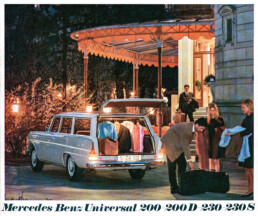
Mercedes-Benz adds the 230 S “Universal” estate to its model range in August 1966. Based on the W 111 executive-class saloon, it offers generously sized load compartment for both leisure and commercial use. The versatile vehicle is thus a predecessor of the Mercedes-Benz T-Models. These lifestyle estates make their debut in the 123 model series in 1977. Mercedes-Benz does not produce the “Universal” itself; instead it is made by Belgian chassis builder IMA in Liège. The 230 S “Universal” continues to be manufactured until 1968. Production of the “Universal” variants based on the four-cylinder “Fintail” saloons (W 110) is more extensive. The 200 D, 200 and 230 are offered in “Universal” form. Technically, the IMA-built estates differ from the saloons in several respects, including their use of 15-inch wheels instead of the saloons’ 13-inch wheels – which increases ground clearance.
11 to 23 September 2001 – 25 years ago
Innovations at the International Motor Show (IAA) in Frankfurt am Main
- Mercedes-Benz unveils numerous new vehicle types at the IAA 2001
- S 63 AMG and CL 63 AMG receive a larger-sized 6.3-litre V12 engine
- G 270 CDI and Vaneo extend the range in the SUV and compact van segment
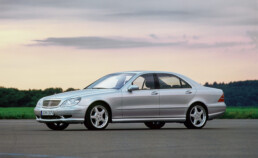
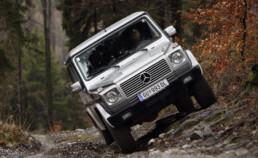
Two exclusive AMG top-of-the-line models head the list of new Mercedes-Benz vehicles presented at the International Motor Show (IAA) in Frankfurt am Main from 11 to 23 September 2001. At the leading motor show, Mercedes-Benz celebrates the 100th anniversary of the Mercedes brand under the motto “The Story of Passion”. Reflecting this theme are the long-wheelbase S 63 AMG (V 220) and the CL 63 AMG (C 215) with the 6.3-litre M 137 V12 engine, producing 326 kW (444 hp). These are the most powerful versions of the S-Class and CL-Class until 2002, when they are followed by the long-wheelbase S 65 and CL 65 with a 6.0-litre turbo V12 engine (450 kW/612 hp). Further IAA premieres include a new entry-level model in the G-Class (model series 463) and the versatile Vaneo (model series 414). The G 270 CDI is powered by a 2.7-litre five-cylinder diesel engine with common-rail direct injection (115 kW/156 hp). It surpasses its predecessors the G 290 D and G 300 Turbodiesel in terms of torque, and is equally suited for on- and off-road driving. The Vaneo compact van takes many components from the A-Class, including the front design with the engine, sandwich-floor concept and front and rear axles. With a payload capacity of 550 kilograms and optional equipment packages such as Surf, Snow, Bike and Carry, it is aimed at customers who have a wide variety of leisure and transport requirements.
4 to 14 October 1951 – 75 years ago
Mercedes-Benz 300 S: Sporty exclusivity in the automotive top class
- Debut at the 1951 Paris Motor Show
- Coupé, Cabriolet and Roadster combine prestige with sporty performance
- Important model for Mercedes-Benz in the US market
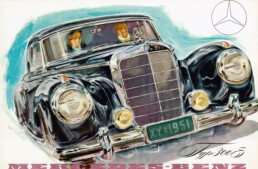
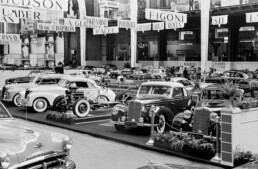
Mercedes-Benz presents the new 300 S type at the Paris Motor Show from 4 to 14 October 1951. The model is offered in three body styles: Cabriolet A, Roadster and Coupé. These sporty, exclusive passenger cars are closely related technically to the prestigious Mercedes-Benz 300 saloon (W 186) They are however assigned their own model series designation, W 188. Compared to the 300 type, Mercedes-Benz refines the character of the especially prestigious and powerful 300 S to deliver even greater exclusivity and sportiness. The 300 S produces 110 kW (150 hp) and is powered by the 3-litre in-line M 188 engine with three Solex downdraught carburettors and a greater compression ratio than the Mercedes-Benz 300. The maximum speed exceeds 175 km/h, making the 300 S one of the fastest German passenger cars of its era. For the brand, the 300 S becomes an important door-opener in the US market of the early 1950s. In 1954, the legendary 300 SL “Gullwing” (W 198) sports car takes over this role with even greater radiance. The further developed 300 Sc, with the M 188 engine, succeeds the 300 S in 1955 (Coupé) and 1956 (Cabriolet and Roadster).
15 December 1926 – 100 years ago
Hanns Klemm takes over Daimler-Benz AG’s aircraft division
- The Klemm light aircraft and F 7502 aeroengine shape civil aviation in the 1920s
- On 15 December 1926, the head of the Sindelfingen design office takes over the aircraft division
- The traditon of aircraft construction at Daimler and Benz dates back to the 1910s
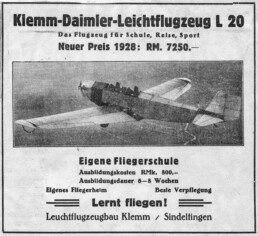
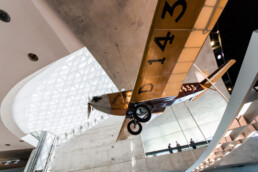
Engineer Hanns Klemm, born in Stuttgart in 1885, takes over the aircraft division of what was then Daimler-Benz AG on 15 December 1926, and founds the company Leichtflugzeugbau Klemm GmbH. This marks his transition from employee to entrepreneur. Prior to this, Klemm had headed the aircraft design office and later the body construction department of Daimler-Motoren-Gesellschaft (DMG) at the Sindelfingen plant. Following the merger of DMG with Benz & Cie., he is responsible for the Mercedes-Benz design office in Sindelfingen. DMG’s tradition of aircraft construction dates back to the year 1915. Klemm’s name is closely associated with light aircraft. In 1922, he initiates production of his own Daimler L 15 design. This is followed in 1924 by the improved L 20 small aircraft, which, from 1925 on, is powered the air-cooled F 7502 flat-twin engine developed by Ferdinand Porsche. The Daimler-Klemm L 20 becomes famous in August 1928, when 22-year-old Friedrich Freiherr von Koenig-Warthausen takes off from Berlin-Tempelhof in his L 20 on a round-the-world flight, which he successfully completes on 22 November 1929. Today, an authentic reconstruction of the L 20 “Kamerad”, the aircraft used by the record aviator, is on display at the Mercedes-Benz Museum.
Birthday
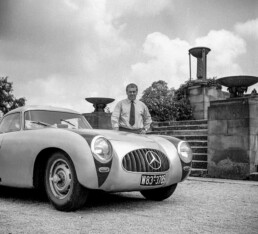
120 years: Rudolf Uhlenhaut is born in London on 15 July 1906, where he also spends his early childhood. After completing his mechanical engineering studies, he joins the Mercedes-Benz Testing Department in 1931. In 1936, he becomes Technical Director of the Racing Department and, in 1949, also assumes responsibility for the Passenger Car Testing Department. Uhlenhaut goes on to become head of passenger car development. The engineer’s philosophy is technically comprehensive; he regards designing a series production car as a more sophisticated challenge than creating a racing car. In the company, his perception is influenced by a combination of engineering authority, driving skill and a sense of humanity. Rudolf Uhlenhaut retires in 1972; he passes away in 1989. The most valuable motor car in the world bears his name: the Mercedes-Benz 300 SLR “Uhlenhaut Coupé” (W 196 S)
Further research and multimedia material:
mercedes-benz-archive.com/marsmuseum
Mercedes-Benz Classic on social media:
https://www.instagram.com/mercedesbenzmuseum
https://www.facebook.com/mercedesbenzmuseum
Mercedes-Benz anniversary year “140 Years of Innovation”
Since Carl Benz filed the patent for the first automobile 140 years ago and Gottlieb Daimler built his motorised carriage shortly afterwards, Mercedes‑Benz has dedicated itself to constant innovation and to creating the world’s most desirable cars for customers. This ambition has driven every innovation – from the world’s first automobile in 1886 to the biggest product launch programme in the company’s history that is currently underway. With its passion for performance and pioneering power, excellence and an unwavering commitment to customer service, the brand has consistently shaped the future of mobility. The result goes well beyond engineering achievement – it creates the unmistakable feeling that runs through everything Mercedes‑Benz does: Welcome home.
Mercedes‑Benz is celebrating 140 years of innovation by driving three new S‑Class saloons on a trans-continental journey to 140 locations worldwide. Each place highlights the brand’s technology, heritage, pioneering spirit and worldwide presence. Along the way, customers, fans and colleagues will get to join in the celebrations – on an epic adventure that will run until October. Follow the “140 Years. 140 Places” drive across six continents on our “140 Years of Innovation | Mercedes‑Benz Media” special and via the Mercedes‑Benz Community.